
At Table with the Holy Family: Healing the Wounds of Home

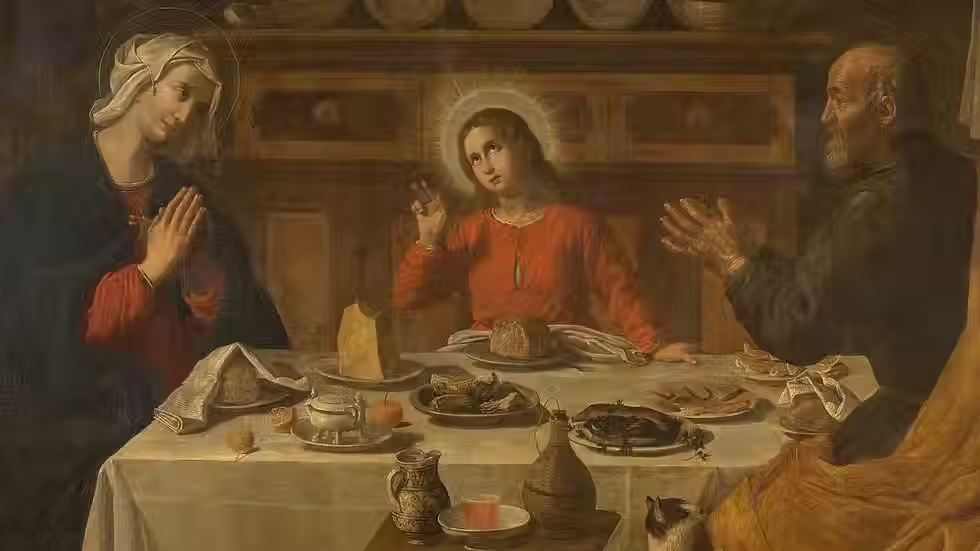
The Holy Family at Table, 17th century, made in Spain
While the painting of the Holy Family at Table is a vivid representation of the importance of the family as the basic cell of society, here, we also receive a profound invitation: to heal our family wounds, which shed light on our identity. Jesus, who sits at the center, invites us to enter into the brokenness of our family. A subtle detail reveals this invitation: the uncovered bread placed before Jesus. While the loaves before Mary and Joseph remain veiled in linen, the bread before Jesus is fully exposed. This small but important detail allows us to realize that Jesus desires that we enter into the mystery of our human brokenness. Just as in the Last Supper, he prays “that they may be one, as we are one,” so here, He invites us to discover that He who is broken for us, enters into our brokenness to bring unity. By receiving Him in Holy Communion, we acknowledge that He who is the “Bread of Life” can bind together the fragments of a fractured home.
Jesus’ desire to unite broken families becomes evident in another important detail. Rather than depicting Jesus as an infant or toddler, he is portrayed as a child of about 12 years of age. Both the uncovered bread before Jesus and the possibility that Jesus is twelve years old are evocative of the meal shared before traveling to Jerusalem for the Passover feast. This plausible speculation reveals that the stability of his home cultivated an environment in which he knew exactly who he was.
For many children and adults today, that environment is-or has been-fractured. When a parent is absent, a piece of the child’s identity is lost. An experience of confusion can cause painful questions to surface: “Where are they?” “Why did they leave?” “Why is my family different?” In these moments, the child Jesus becomes a companion to those who feel lost amidst their family’s brokenness. Thus, this painting presents an opportunity to journey not only with adults seeking healing, but to accompany children who are navigating life without a mother or father figure. The plates in the background become the invitation our hearts desire, to be part of a family. Healing becomes possible when we take our place at the dining table with the Holy Family. In the home of Nazareth, the individual seeking healing learns that unity is not found in a lack of struggle, but in a shared experience of the ordinary activities of daily life - struggling to cook a meal after a long day of work, not wanting to talk when a difficult day at school or work affects our mood. Amidst all of our human experiences, even though a parent may be absent in our lives, in the home of Jesus, Mary, and Joseph, the human heart’s deepest longing for communion is fulfilled as Jesus gives Himself–the bread that is always present, always enough, and always ready to give Himself in love.


